While e-commerce is taking off at national level, it is still relatively uncommon for consumers to use the internet to purchase goods or services in another Member State. The gap between domestic and cross-border e-commerce is widening as a result of cross-border barriers to online trade. From 2006 to 2008, the share of all EU consumers that have bought at least one item over the internet increased from 27% to 33% while cross-border e-commerce remained stable (6% to 7%). One third of EU citizens indicate that they would consider buying a product or a service from another Member State via the internet because it is cheaper or better.
Showing posts with label EU. Show all posts
Showing posts with label EU. Show all posts
22 October 2009
Internet retailing in the EU
While this is a little bit off-topic for this blog, I found this EU report interesting. In particular, there is potentially useful data in Annex 1. From the executive summary:

11 September 2008
Regulation of Text Messaging?
In this previous post, I had discussed rising text message rates in the US. According to this article in Forbes, it has gotten the attention of Sen Herb Kohl (D-Wis) as well. Here is the announcement from his website. While specific action is unlikely in this session given the upcoming election, Forbes notes a possible connection with the EU's action on mobile phone price regulation.
While Kohl blames this on industry consolidation, I believe that there are other interpretations that should be considered. For one, the price increase is for a-la-carte messages, not for packages or bundles of messages. Second, carriers often offer cheap or free messages between users in their networks as a way to increase switching costs for users. Should they be prevented from doing this?
05 September 2008
U.S. 3G Adoption Rivals Europe
Those of you who like to keep score might find this item interesting. It would be interesting to take comparative look at pricing for these services as well. In any case, I guess it pretty much renders moot the discussions about the different airtime charging schemes (caller pays vs. mobile pays) and multiple standards!
01 July 2008
Payphones again
In reading the EU Household Usage report I blogged about earlier, I came across their study of payphone usage in the EU. So, to follow up on this item, consider what the EU found. The percentage of people reporting that the "sometimes" use payphones ranges from a high of 34% (Austria) to a low of 3% (Cyprus) with an EU mean of 22%. 44% of payphone users report doing so because their mobile phone is out of range or its battery has run out, while 19% report not having a mobile phone and needing to place a call while travelling and 16% report not using their mobile phone due to high international tariffs.
Very interesting. I will have to search out similar data in the US. Anecdotal evidence is that payphones are disappearing in the US, which would make it difficult to use them! Do you have any data about payphone use elsewhere in the world?
Very interesting. I will have to search out similar data in the US. Anecdotal evidence is that payphones are disappearing in the US, which would make it difficult to use them! Do you have any data about payphone use elsewhere in the world?
27 June 2008
EU Household communications survey
This report was released today. It is a wide ranging report (released annually) that examines the use of communications services by households in the EU. Because the report is lengthy, I haven't had a chance to review it fully yet.
In my cursory review, there was one datum -- households with mobile only access, that I wanted to compare with the US. The result? According the the EU report, the number of wireless only households grew to 24% from 22% the year before (figure from p. 10 of the report).

In this item, I had reported a similar study of US households by the CDC. It shows that 14.5% of US households are in a similar position, up from 12.6% of households in the previous year. So, the trends are in the same direction on both sides of the Atlantic, though the percentages are different. Here is how it breaks out by country:

11 June 2008
Carriers hike non-EU roaming rates
I have been sitting on this story for a while. The lesson is that firms respond to regulation in many different ways:
European wireless carriers have sharply raised prices for making and receiving calls outside the European Union to compensate for regulator-imposed lower tariffs within the EU, a market research firm said.
Informa Telecoms and Media said on Friday roaming charges had risen as much as 163 percent since the EU capped rates last year at 0.49 euros ($0.76) a minute for making calls abroad in the 27-nation bloc and 0.24 euros for receiving them.
The average price of a call home by an Italian subscriber in Russia was 3.67 euros a minute in 2006, but this has risen 25 percent to 4.58 euros, Informa said.
For customers in most European countries, the cost of roaming in Africa, China, India, Japan, the Middle East, Russia and the United States has risen, the Informa data showed.
21 March 2008
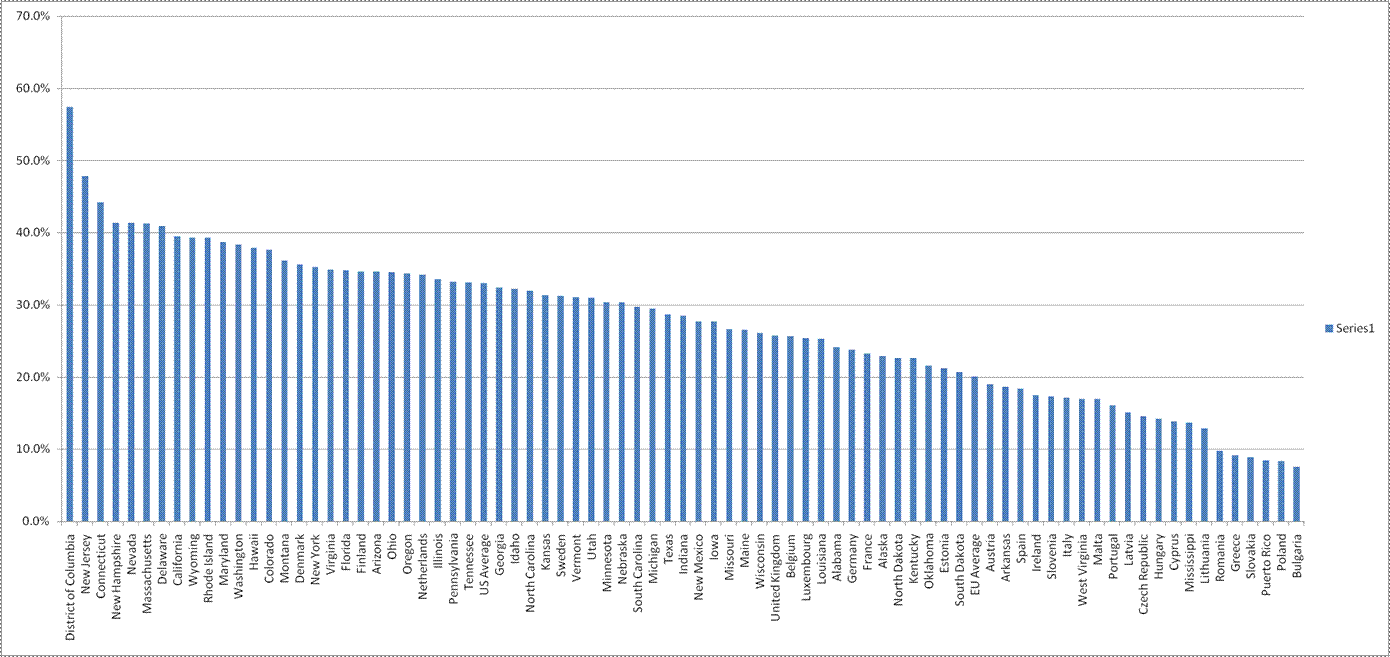
US/EU Broadband Comparison
Sean Donelan posted combined the data from the FCC and the EU report, and recalculted, eventually producing this chart (go here for the original):
20 March 2008
Broadband technologies in the US
The FCC released its latest report on broadband penetration (incidentally right on the heels of the EU's Review). While these broadband reports have been criticized, and the FCC will be adopting new reporting technologies (see this summary over at CNET), the data on technology use are still interesting and useful.
I have culled this graphic from Table 3 of this report. Plotting it in on a semi-log scale highlights the fastest growing technologies in addition to the ones in greatest use. You can see that, while cable modems are the dominant technology, followed closely by ADSL, the most rapid growth is in fiber and wireless. This should surprise no one, but it is interesting to see it graphically.

I have culled this graphic from Table 3 of this report. Plotting it in on a semi-log scale highlights the fastest growing technologies in addition to the ones in greatest use. You can see that, while cable modems are the dominant technology, followed closely by ADSL, the most rapid growth is in fiber and wireless. This should surprise no one, but it is interesting to see it graphically.

30 November 2007
EU Declines to Set Mobile TV Standard
This article in Forbes, which reports that the EU Telecommunications ministers, who are meeting in Brussels this week, declined to endorse the adoption of a standard for mobile television (I haven't yet found the original announcements). According to the article:
But EU telecommunications ministers said this time that it was important to let the market decide which type of mobile TV it prefers - and the European Commission should stick to "technology neutrality." They said DVB-H should be a "non-mandatory standard" among other options.Not surprisingly, the EU Commissioner Viviane Reding was concerned with this laissez-faire attitude, warning that "Europe risks losing its competitive edge unless it moves fast".
This is a truly surprising announcement, coming from the region that mandated the GSM air interface. Many European cognescenti have expressed concerns about the US's refusal to set such a standard. This makes this development so much more remarkable!
13 November 2007
EU announces new (proposed) telecom regulation framework
In case you missed it, you might find this of interest. If you follow the links, you can get to the (draft) legislative documents. Note that these documents do not represent final policy, though it seems likely that the final policy will be close to what is published today.
- As expected, functional separation is one of the options available to regulators. Do you think that this will be widely used?
- The framework proposes a "European Telecom Market Authority". How do you think this will play out, especially with regard to NRAs?
- What about the spectrum reform proposals? Will they help?
Anyway ... enjoy your reading!
Update (2007-11-14): Here is Forbes' take on this announcement and here is CNET's. Interestingly, few of the major news outlets reported on this.
Update (2007-11-15): This item reports that French and German regulators question the need for the Telecom Market Authority. Will this reform proposal face a long road to adoption?
12 October 2007
Vivian Reding on Telecoms regulation
You might find this speech by EU Commsioner for Information Society and Media interesting. Here are some points from her speech:
As you would expect, there are many caveats to those points in the speech. It clearly is a preview to the new regulatory frameork that will be forthcoming in the next month.I have come to the conclusion that the instrument of functional separation should be added to the remedies tool box of national telecom regulators ...
... a symbol for the single market for telecoms is the creation of the new European Telecom Market Authority which will be an integral part of the reform package.
18 September 2007
Microsoft and the EU
As has been widely reported (see this), Microsoft's appeal of the European Commission's decision failed. This story in BusinessWeek and this one in the NY Times begin to contemplate some of the longer term consequences of this decsion beyond Microsoft.
Some of the other cases mentioned involve Qualcomm and other firms that have technologies that are either de facto or de jure standards. If the markets that these firms compete in benefit from standards, should the firms whose technology has been adopted by the marketplace be subject to government scrutiny or intervention? Should a de jure process exempt firms from this?
More broadly, how much should the government manage competition? Do consumers benefit from this kind of intervention? What should be the standard for determining "successful" government intervention?
Update (2007-09-18): Here is an analysis from TLF.
Update (2007-09-21): I found this item to be a worthwhile read. Do you agree or disagree?
Update (2007-09-25): This article suggests that smaller companies may begin "venue shopping" in the EU in order to gain favorable rulings. Is this a good development?
Update (2007-09-26): This item is critical of the EU ruling, and frames the Antitrust fine as a tariff that bypasses the WTO. Do you think this has merit?
10 September 2007
Structural Separation
There has been a bit of a debate going on that argues, in essence, since network neutrality seems infeasible, let's separate transport from services. BT in the UK has taken this approach, which has apparently been hailed by EU Commissioner Viviane Reding. I have a few questions about this idea:
- We have tried structural separation in the past in the US ... some of us remember Computer I and Computer II. Is this proposal different? Why? How?
- While structural separation, in theory, does remove incentives on the part of network operators to discriminate, to what extent would infrastructure investments be inefficient? That is, can transport providers make more efficient investments if they know (and can confidently predict) upcoming services and their deployment? Part of this is a problem of opportunism and asset specificity that Williamson predicted would result in increased transaction costs (and hierarchy).
- Assuming that the above questions are resolved, how would this be implemented? Do you think it could happen voluntarily (as it did in the UK)?
27 August 2007
Comparative mobile rates
I have compared US and European mobile rates in previous blog posts. Along that line, this paper (by way of the PFF blog) is relevant. It contains a systematic comparison of the US mobile communications market to those of our main trading partners. The results of this analysis might be surprising to some.
Difficulties with the data remain, for example:
This figure says a lot about the conclusions:

The report's conclusion reads:
Do you believe the results? If it is true that the market concentration is low compared with many of our trading partners, is it still high enough to be of concern to regulators?
Update (29 Aug 2007): You might be interested in this related item over at ARS Technica.
Difficulties with the data remain, for example:
This report has shown that the U.S. market has lower market concentration, more competitive prices and greater acceptance among consumers. However this finding is counter to published international data on market penetration. The problem with these international statistics is that they do not count the same things. In the U.S., wireless subscriptions primarily reflect the number of handsets in operation. However, in the Europe, the statistics reflect the number of Subscriber Identity Module (SIM) cards. Because European roaming rates are so high between countries, it is sometimes economical for consumers to have more than one SIM card per handset, in order for consumers to take advantage of lower in-country rates.
This figure says a lot about the conclusions:

The report's conclusion reads:
The data from the OECD and FCC show that European wireless markets have higher concentration, higher prices and lower usage. From this analysis, the U.S. wireless market gives consumers more choice, offers more competitive prices and encourages more consumption. Compared to Europe, reported problems of high market concentration, high consumer prices, low usage and decreasing consumer welfare do not appear to be a U.S. problem. In summary, there is no evidence of market failure or that the U.S. wireless market somehow lags behind the European wireless market. In fact, if anything, basic comparisons of consumer welfare between these markets demonstrate the opposite conclusion.
Do you believe the results? If it is true that the market concentration is low compared with many of our trading partners, is it still high enough to be of concern to regulators?
Update (29 Aug 2007): You might be interested in this related item over at ARS Technica.
26 July 2007
Broadband in France
I found this article in BusinessWeek interesting. While I will leave it to you to read the article in detail, the article attributes the increase in broadband access to local loop unbundling. The prices set by the French regulator encouraged entry, which was praised in the article; in comparison, the article points out that the unbundled prices in the US were set too high to encourage widespread entry. The article does not discuss whether the prices in France are compensatory, though it does imply that the prices in the US were predatory. Interestingly, the article criticizes the facilities-based competition bias of the US, while concluding the article with the desire on the part of a French CLEC to build its own facilities. Also, to some extent, the French experience is driven by EU policy.
Is facilities-based competition the desired outcome, in the end? Are the criticisms of the US approach to unbundled local loop warranted?
Is facilities-based competition the desired outcome, in the end? Are the criticisms of the US approach to unbundled local loop warranted?
24 July 2007
Mobile television
This item on Om Malik's blog is interesting, especially in light of the recent EU decision. We appear to be heading into a fragmented technology marketplace, with two competing technologies in South Korea, one in Europe, and another which appears to be a winner in the US (see this).
Update (2007-7-26): You might also enjoy this article in BusinessWeek, which discusses this topic in a bit more detail.
Does it matter that there may be several global standards? If so, why do you think so?
Update (2007-7-26): You might also enjoy this article in BusinessWeek, which discusses this topic in a bit more detail.
Does it matter that there may be several global standards? If so, why do you think so?
19 July 2007
EU Endorses Cell-Phone TV Standard
I guess this has been Europe week ... I found this item interesting:
South Korea currently has two rival systems for mobile video and is most likely further along than most on this, both in terms of business models, consumer adoption and deployment.
Do you think it is necessary to have a single standard as opposed to allowing for competing standards? What factors other than licensing fees do you think may have played a role in this outcome?
The European Commission on Wednesday endorsed a Nokia-backed mobile TV standard called DVB-H, saying Europe needed to pick one technology over others and promising to look at ways to mandate its use.
Europe's choice of DVB-H, or Digital Video Broadcasting for Handhelds, was expected. The move will likely prevent rival standards, such as U.S.-based Qualcomm Inc.'s MediaFLO and others developed by Chinese and South Korean manufacturers, from gaining ground in the world's richest market.
South Korea currently has two rival systems for mobile video and is most likely further along than most on this, both in terms of business models, consumer adoption and deployment.
Do you think it is necessary to have a single standard as opposed to allowing for competing standards? What factors other than licensing fees do you think may have played a role in this outcome?
18 July 2007
Mobile WiMAX in Europe
This article frames mobile WiMAX as a disruptive technology in the European telecommunications market. The essence of the article is this:
Do you think this article is correct? Does WiMAX match the criteria for a disruptive technology laid out by Christiansen in his book?
For the past 15 years, American tech giants such as Intel and Microsoft have been largely shut out of the European-dominated mobile phone industry. Not that they haven't tried—Intel (INTC) made processors and memory for handsets and Microsoft (MSFT) is still pushing a pint-sized version of Windows for handheld devices. But the business was still largely controlled by telecom companies such as Nokia, Ericsson, and Vodafone.
Now, with the pending arrival of a disruptive new wireless technology called Mobile WiMAX, the U.S. crowd stands its best chance in years at knocking down Fortress Europe. A kind of Wi-Fi on steroids, Mobile WiMAX delivers data at speeds comparable to conventional third-generation (3G) mobiles but promises to be cheaper to implement because it uses newer, more efficient technology.
Do you think this article is correct? Does WiMAX match the criteria for a disruptive technology laid out by Christiansen in his book?
17 July 2007
US vs. European wireless
You might find this item interesting, as I did. This is a more comprehensive analysis than the one that I posted earlier.
Why did these two industrialized markets obtain such different outcomes? Why was it necessary for the EU to regulate roaming rates when no such regulation was necessary in the US?
Why did these two industrialized markets obtain such different outcomes? Why was it necessary for the EU to regulate roaming rates when no such regulation was necessary in the US?
18 April 2007
EU roaming price caps ... the carriers respond
I have blogged about these price caps before. They seem destined to pass at this point according to most news reports. This article points out an interesting response that some carriers are (apparently) developing:
Apparently, this is not without precident:
Does this surprise you? How does this compare with the market activities of US carriers? Do you think this will boost the market for unlocked GSM phones?
Update (2007-04-19): According to this article, the Austrian operator mobilkom will raise their rates in response to this new price regulation.
Update (2007-04-23): Here is another article that expands on the previous one.
Update (2007-05-08): This article in BusinessWeek highlights just how difficult it is to reach an agreement on price, especially when there are heterogeneous usage patterns.
Update (2007-05-18): The deal is done. See this.
Visitors to Europe may find they have to pay increased roaming charges as a result of price caps being imposed on calls within the EU.
According to analysts at Informa, a number of European mobile operators say they will increase the wholesale prices they charge non-European operators whose customers roam onto their networks, to "compensate for the loss of revenues resulting from the new European price caps".
Apparently, this is not without precident:
Mark Newman, an Informa analyst, said: "What we are beginning to see here is the emergence of a two-tier market for roaming services. With the new price caps and the emergence of pan-European groups, such as Vodafone, Telefónica O2 and Orange, Europe is going to start resembling a single market in terms of retail prices. When people want to use their phones outside of their countries or regional groupings, they will pay a substantial premium."
Newman pointed to the example in India, where domestic operators charge foreign operators 30 times the wholesale rate they charge other local carriers. He said European operators may demand a reduction in these fees, or may retaliate with a punishing reciprocal arrangement if cuts are not forthcoming.
Does this surprise you? How does this compare with the market activities of US carriers? Do you think this will boost the market for unlocked GSM phones?
Update (2007-04-19): According to this article, the Austrian operator mobilkom will raise their rates in response to this new price regulation.
Update (2007-04-23): Here is another article that expands on the previous one.
Update (2007-05-08): This article in BusinessWeek highlights just how difficult it is to reach an agreement on price, especially when there are heterogeneous usage patterns.
Update (2007-05-18): The deal is done. See this.
Subscribe to:
Posts (Atom)