Showing posts with label FCC. Show all posts

12 March 2010

Verizon FiOS buildout

This story is interesting:
They [Verizon] have now canceled planned FiOS deployments for all new territories such as Alexandria, Virginia. According to Bryant Ruiz Switzky in the Washington Business Journal, Verizon is "suspending Fios franchise expansion nationwide." They are "indefinitely postponing" building Alexandria after telling the city they would begin construction several months ago. Alexandria is one of the richest suburbs in the world and a natural part of the network with a lower than average likely construction cost. Verizon "will now focus on installing its network and gaining market share within the areas where it already has agreements." Bostonians and 10M other Verizon customers are apparently screwed.

Verizon has buildout commitments to New York and other cities that will keep some crews working, but had already suggested they might cut FiOS builds by 2/3rds in 2011. This is now a further cutback, canceling areas that for years they had been promising to serve. Verizon's Harry Mitchell sends their perspective. "The bottom line is that Verizon said in 2004 we’d build to pass about 18 million homes by year-end 2010, and we’re on track to do that with the franchises we currently have. Of course, we will also meet any buildout commitments we made in individual jurisdictions beyond 2010."

The article goes on to speculate that Verizon is hoping to get Federal support for this buildout under the broadband plan. If this is the case, then it is a classic illustration of the "moral hazard" of government interventions in markets. Why should a company take private risks when public funding is available?

But this may not be the only explanation. Others have speculated that the business case for FiOS (and similar systems) is weak to begin with. If this is the case, then Verizon's actions are rational.

30 December 2009

Challenges with phasing out landlines

This commentary over at GigaOm is insightful and worth reading. In it, Stacey Higginbotham reflects on this AT&T filing at the FCC. Some excerpts from the filing:
Over 99% of Americans live in areas with cellular phone service, and approximately 86% of Americans subscribe to a wireless service. Many of these individuals see no reason to purchase landline service as well. Indeed, the most recent data show that more than 22% of households have “cut the cord” entirely.

Demand for VoIP service – from both cable companies and over-the-top providers such as such as Vonage, Skype, and many others – is also booming. At least 18 million households currently use a VoIP service, and it is estimated that by 2010, cable companies alone will be providing VoIP to more than 24 million customers; by 2011, there may be up to 45 million total VoIP subscribers.

Today, less than 20% of Americans rely exclusively on POTS for voice service. Approximately 25% of households have abandoned POTS altogether, and another 700,000 lines are being cut every month. From 2000 to 2008, the number of residential switched access lines has fallen by almost half, from 139 million to 75 million. Non-primary residential lines have fallen by 62% over the same period; with the rise of broadband, few customers still need a second phone line for dial-up Internet service. Total interstate and intrastate switched access minutes have fallen by a staggering 42% from 2000 through 2008. Indeed, perhaps the clearest sign of the transformation away from POTS and towards a broadband future is that there are probably now more broadband connections than telephone lines in the United States

The public policy problem, of course, is what to do with the 20% that do not have connections. Further how about those people who use the copper PSTN plant for DSL access (whether from a telco or a reseller)?

It seems that the hard problems with public policy is dealing not with the majority but with the marginal.

30 November 2009

Unintended consequences of price regulation: Traffic pumping

This order reveals the practice known as "traffic pumping". I believe that it is a good example of arbitrage that results from price regulation (footnotes deleted):

2. Qwest is an interexchange carrier, serving customers throughout the United States. Farmers is the incumbent local exchange carrier in Wayland, Iowa, serving approximately 800 access lines for local residents. Farmers provides local exchange and exchange access services. Qwest purchases tariffed access service from Farmers, which enables Qwest’s long distance customers to terminate calls to customers located in Farmers’ exchange.

3. In 2005 and 2006, Farmers entered into a number of commercial arrangements with conference calling companies for the purpose of increasing its interstate switched access traffic and revenues. Under the agreements, conference calling companies sent their traffic to numbers located in Farmers’ exchange and, in return, Farmers paid the companies money or other consideration. The agreements resulted in a substantial increase in the number of calls bound for Farmers’ exchange. As a result, the amounts of Farmers’ monthly bills to Qwest for terminating access charges rose precipitously.

23 November 2009

Economics in the wireless industry

This item over at the tech. liberation blog is fascinating. It makes clear the deeper battles going on releated to "wireless network neutrality". I am becoming more convinced than ever that the network neutrality discussion is largely a question about political economy -- that is, who gets which revenue and who pays which costs. But is allocating more spectrum to mobile, as the article goes on to suggest, the answer?

20 November 2009

Regulation and cloud computing

This item over at the Tech Liberation blog got me thinking about regulation and cloud computing. Given the underlying economies of scale and scope, it seems to me to be almost certain that we'll see concentration in the market for cloud services. Thus, is it too soon to be thinking about marketplace rules for cloud computing? After all, we haven't seen serious market abuses (that I know of). If so, is the FCC the right agency to do this? As the article points out, there is no real statutory authority to do so. On the other hand, cloud computing is a deep integration between processing and communication to provide a service, so it is easy to see how they might be tempted to move in this direction. Where would you draw the line between communications and processing in cloud computing?

24 August 2009

Google voice and the iPhone

The dust-up around the Google Voice iPhone application has been fun to watch (see this for an update). There are many things going on here, including (possibly) AT&T's involvement (which both it and Apple deny). I found this item over at TechCrunch an interesting analysis of Apple's response to the FCC's inquiry.

I have to agree that it seems largely about Apple's control over users. AT&T would get either the data traffic or the voice traffic and, unless there is a serious difference in the profitability of one service over another, they should be largely indifferent.

Welcome to life in Apple's walled garden.

Update: The plot thickens ... according to this item, AT&T and Apple did have an agreement regarding VoIP, but it did not cover third party apps.

04 March 2009

We should have seen this coming ...

It seems that many FCC decisions are challenged in Appeals Court, so this one, challenging the "white spaces" decision, shouldn't come as a surprise. This could turn into an entertaining "food fight", though, pitting the powerful National Association of Broadcasters (NAB) against the well connected White Spaces Coalition.

On a related note, you might find this editorial by Tom Hazlett interesting. Hazlett writes:

The new Obama Administration got Congress to fast-track an 11th-hour delay, pushing back the mandatory analog switch-off until June 12, 2009.

But many TV stations wanted to cut their analog broadcasts anyway. In truth, they believe that over-the-air transmissions are a waste, not worth the electricity it takes to send them. Hence, some 420 TV stations pulled the plug last week, joining another 200 analog stations that had already signed off.


Later in the article, he writes:
One hundred million households now pay $600 or so per year to avoid [over the air broadcasting], subscribing to cable or satellite. Well over 90 per cent of TV viewing takes place in households opting out of broadcast delivery. And for a very small additional investment – no more than $3bn – every last rabbit-eared home in America could join them.

Yet, the US is subsidizing off-air receivers; $1.5bn has been allotted for digital set-top converters (two $40 vouchers per family), and the Obama “stimulus” pumps in $650m more. This is not merely money down the drain. In extending life-support to DTV signals that hog hugely valuable frequencies, consumers lose hundreds of billions worth of wireless service. The bandwidth available to iPhones, Blackberrys and GPhones and other emerging technologies would double were TV air waves to accommodate mobile apps as requested in 1985.

Why don’t all broadcasters – digital and analog – just unplug? First, their licenses mandate that they broadcast TV signals, and they cannot legally sell the air waves used for more valuable services. And second, because their signals continue to reach one key target audience: Congress. Those appreciative entertainment fans reward stations with “must carry” rights forcing cable and satellite operators to provide their subscribers all local channels. The off-air transmission is a side show; gaining free cable carriage the main event.


If you agree with Hazlett's viewpoint, the NAB's challenge to the white spaces decision is consistent with a "do whatever it takes" strategy to preserve the existing business model, regardless of whether they are viable in the long term.

02 March 2009

New spectrum license fee in the US?

Spectrum license fees are one way to encourage spectrum users to use spectrum efficiently. The trick is to set the fees properly; if they are set too high, then spectrum will be underutilized with respect to their social benefit, and set too low and it doesn't accomplish efficient utilization. On page 126 of his recent budget proposal, the President is proposing increasing revenues from spectrum licenses to US$550M to US$50M over four years, 1000% increase.

There is little but speculation about which spectrum will be taxed, since the Office of the President is apparently saying little about this. The PFF has remarked that, if applied to mobile carriers (which have already paid for licenses through auctions), the tax is quite regressive. According to this item, this fee may just apply to broadcasters. If this is the case, it will help motivate broadcasters to refocus on being programming producers (and possibly aggregators) since it will cost them ever more to transmit their product to an ever-diminishing audience at even higher costs than before. Michael Marcus just posted this related item.

24 February 2009

A couple of telecom-related URLs

I need to break the "radio silence" ... I've been pretty busy with administrative projects and travel, so blogging has taken a back seat.

I have been working on dynamic spectrum access (DSA) for a number of years now. A paper on one of my projects, together with Arnon Tonmukayakul, is coming out in Netnomics shortly. In addition, I presented a paper on DSA and the FCC White Spaces decision at the recent iConference. Hopefully, the papers will be made available soon.

So, given this, I found this site to be of interest. You can use it to find the TV white spaces at a particular address.

If you go back through this blog, you'll find that I have been interested in (OK, critical of) comparative studies of broadband penetration. So, I found this site interesting, which looks at broadband from the point of view of connectivity rather than penetration. From this perspective, rankings (for what they're worth) look quite different.

02 December 2008

Audit of US "High Cost" Universal Service program

This item, the report of an audit of the US "High Cost Support" program, is a bit obscure and technical, but nonetheless points out some of the problems with centrally funded and managed universal service programs. In the executive summary, the document reports the following:

To assess compliance and risk, a stratified random sample of 390 service area providers (represented by unique Study Area Codes, or "SACs") was drawn and compliance attestation examinations/audits were completed. Audit data were provided for 384 auditees. Under IPIA standards, a program is "at risk" if the erroneous payment rate exceeds 2.5% and the amount of erroneous payments exceeds $10 million. The estimated erroneous payment rate for this HC audit cycle was 23.3% and the margin of error was 2.3% at the 90% level of confidence. The statistical estimate of erroneous HC payments during FY 2006 is $970.3 million. The rate of overpayment out of total disbursements was 22.8% with a margin of error of 2.3% at the 90% confidence level. As a consequence, statistical results from this sample indicate that the HCF USF program is "at risk" as defined by the IPIA.

Elsewhere in the report (p. 21), this was elaborated further:

The rate of improper over payment is 22.8%, and the proportion of improper over payments out of total improper payments in 98.2%.

So, basically, when there was an improper payment, it almost always was an over payment (Are you surprised?). We (users of the telephone network) paid almost 23% more than we needed to. Put another way, almost 1/4 of the collected funds (approximately $4.4 billion in FY07) were over payments!

The US Inspector General, in their report to Congress, noted

The results from Round 1 and the preliminary results from Round 2 have not lessened our concern about the possibilities for fraud, waste, and abuse in the Commission's USF programs as administered by USAC.

Thus, this is an ongoing problem that hasn't (apparently) gotten any better since the last audit!

24 November 2008

Universal services and eligible services

The three major issues in a universal service program are determining the funding mechanisms, identifying which carriers are eligible to receive support (for centrally funded programs) and identifying the services to be included in the "universal service" definition. The US FCC has recently defined eligible services for one of its universal services programs -- the schools and libraries program (see this for the details).

04 November 2008

TV White spaces

This issue is on the agenda today at the FCC, and it was a major topic at the recent IEEE DySPAN. The technology is intriguing, and it is hard to argue with using otherwise unused spectrum for new services. Like some others (see, for example this item over at Broadband Consensus and some of Tom Hazlett's articles, like this one over at Ars Technica) I am coming to the conclusion that we're going about this all wrong.

Given that a small percentage of households receive over the air TV, shouldn't we really be discussing doing away with that technology, and encourage broadcasters to change their business model to being pure programming providers, instead of bundling programming with delivery techniques?

The reason this is important to discuss now is that many of the white spaces devices are optimized for the particulars of the TV spectrum. If this becomes unlicensed use, then the existing channelization becomes effectively locked in because it is difficult to coordinate disparate unlicensed users to transition to a new channelization regime. Is this in the best long term interest?

16 July 2008

GAO Report on High Cost Universal Service Program

You might find this report of interest. The short story is:
The high-cost program’s structure has resulted in the inconsistent distribution of support and availability of services across rural America. The program provides support to carriers in all states. However, small carriers receive more support than large carriers. As a result, carriers serving similar rural areas can receive different levels of support. Currently, the high-cost program provides support for the provision of basic telephone service, which is widely available and subscribed to in the nation. But, the program also indirectly supports broadband service, including high-speed Internet, in some rural areas, particularly those areas served by small carriers. The program provides support to both incumbents and competitors; as a result, it creates an incentive for competition to exist where it might not otherwise occur.

There is a clearly established purpose for the high-cost program, but FCC has not established performance goals or measures. GAO was unable to identify performance goals or measures for the program. While FCC has begun preliminary efforts to address these shortcomings, the efforts do not align with practices that GAO has identified as useful for developing successful performance goals and measures. For example, FCC has not created performance goals and measures for intermediate and multiyear periods. In the absence of performance goals and measures, the Congress and FCC are limited in their ability to make informed decisions about the future of the high-cost program.


This report is highly critical of the FCC and its management of these monies. There is no statement on the FCC Website (that I have been able to find, anyway).

21 March 2008

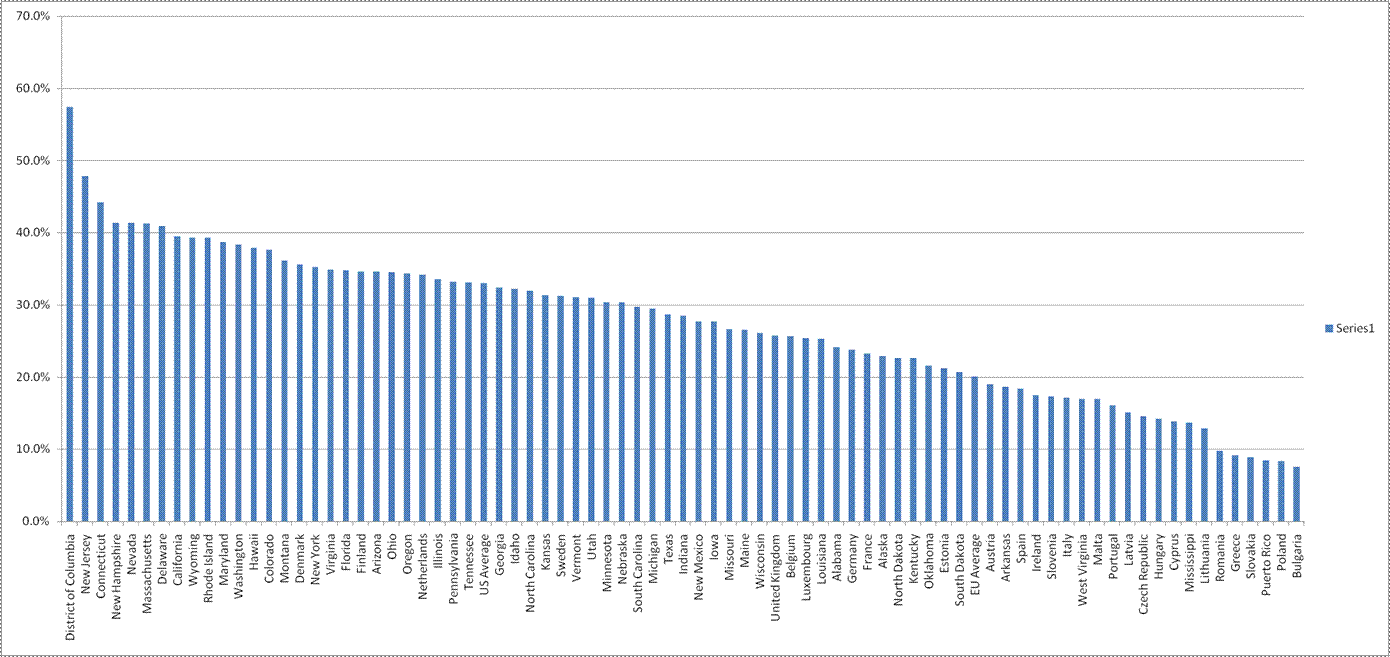
US/EU Broadband Comparison

Sean Donelan posted combined the data from the FCC and the EU report, and recalculted, eventually producing this chart (go here for the original):

20 March 2008

Broadband technologies in the US

The FCC released its latest report on broadband penetration (incidentally right on the heels of the EU's Review). While these broadband reports have been criticized, and the FCC will be adopting new reporting technologies (see this summary over at CNET), the data on technology use are still interesting and useful.

I have culled this graphic from Table 3 of this report. Plotting it in on a semi-log scale highlights the fastest growing technologies in addition to the ones in greatest use. You can see that, while cable modems are the dominant technology, followed closely by ADSL, the most rapid growth is in fiber and wireless. This should surprise no one, but it is interesting to see it graphically.

19 March 2008

700 MHz Auction (No. 73) Ends

The FCC ended its latest auction yesterday (see this announcement). The figure below, from the FCC, shows that proceeds from this auction as compared with previous auctions). The winners of the auction have yet to be announced.

17 January 2008

Telecom complaints at the FCC

The FCC regularly reports the complaints from consumers that they receive. Here is the latest report. I compiled the summary data into this graph (note that they vertical axis is logarithmic):


There was obviously something going on in January and April that stimulated complaints!

08 January 2008

US Telecom revenues by source


You might find this graph interesting, which was derived from data reported on FCC Form 499-A. I think it shows what we have all been experiencing ... declining wireline and increasing wireless. The data are in $US millions and the y axis is logarithmic. I do not believe that these are in constant dollars.


Note the decline in payphone revenues, wireline, and toll revenues and the increase in revenues for companies classified as wireline competitors (my words, not the FCC's) and, of course wireless providers. This data has wireless providers' revenues exceeding wireline ... I think that is because it is aggregated data.

04 January 2008

Update on the Fairpoint case

I thought you might be interested in an update of this item, posted earlier. As Forbes reported today, the Maine PUC approved Fairpoint's acquisition of Verizon's lines in its state. Recall that Vermont did not approve this.

Questions about appropriate regulation or inappropriate micromanagement aside, I think this case provides an interesting window into the machinations necessary in telecom for commercial transactions such as this. These kinds of processes are not required in other industries and adds to the "friction" of these markets, which leads to economic inefficiency. Quoting the article:

The deal also requires approval from Vermont and New Hampshire regulators. On Dec. 21, Vermont's Public Service Board rejected the deal but invited the company to submit a revised application. New Hampshire's PUC staff recommended against the initial proposal, but it is also willing to consider a revised deal.

The deal is subject to review by the Federal Communications Commission.

Maine's PUC attached several conditions to its approval. The commission suggested reducing FairPoint's debt to Verizon by $100 million by scaling back fees FairPoint will pay to lease equipment from Verizon Communications.

Verizon general counsel Don Boecke dismissed that approach as "pretty much a nonstarter," but left the door open to an alternative. FairPoint Chief Executive Officer Gene Johnson then told the PUC a number of options that would have the same financial impact were available.

Some of those include reducing dividends, selling noncore assets, selling more stock and suspending dividends if necessary, he said.

Other conditions ordered by the PUC included having FairPoint develop and implement a policy protecting customers' privacy, and not having the other two states' regulators materially change FairPoint's financial condition.

Johnson said he did not see the latter condition as a problem, saying he believes the agreement approved in Maine will serve as a "roadmap" in New Hampshire and Vermont.


Update (2008-1-15): The FCC approved this transaction (see the order for details):
In accordance with the terms of sections 214(a) and 310(d), we must determine whether the Applicants have demonstrated that the proposed transactions would serve the public interest, convenience, and necessity. Based on the record before us, we find that the transaction meets this standard. We conclude that it is unlikely the merger will result in any anticompetitive effects or other public interest harms. Specifically, the Applicants do not compete in any of the relevant local exchanges. Moreover, after consummation of the transaction, the Applicants will compete for large business and long distance customers. The transaction also is likely to produce public interest benefits, including the accelerated deployment of broadband throughout the region.

Note that the FCC's analysis is motivated by a different set of concerns than the states' ... the latter group is interested (at least on paper) in the viability of Fairpoint after the transaction. This difference can be seen in Commissioner Copps's dissent.

31 December 2007

Inside the spectrum auction

This article in Forbes provides an interesting insight into the workings of the upcoming 700 MHz auction. Since Forbes doesn't do permalinks, I will quote from the article more liberally than I prefer to:


If you're a 150-person start-up going up against the likes of AT&T, Verizon and Google in the upcoming auction of wireless spectrum, you look for any advantage possible.

Towerstream, a tiny Middletown, R.I.-based fixed-wireless Internet provider, is hoping telecom lawyer Dee Herman will give it a leg up against the competition. Herman, a principal at Bennet & Bennet, is part of a cottage industry of lawyers, consultants, engineers and economists that companies are hiring to boost their chances in the closely watched Federal Communications Commission auction that could redefine the telecommunications industry.

[snip]

Experts say larger companies are more likely to have in-house teams that assess the value of particular slices of spectrum and come up with different bidding scenarios Those with fewer resources are hiring outside consultants and lawyers, who may, in turn, work with bankers or economists to devise strategies. Even Google, which has set up a war room at its Mountain View, Calif., headquarters, is consulting with auction experts and game theorists to gain an edge over the competition.

Consultants and lawyers usually file the applications on behalf of companies. They also get tapped for a multitude of other tasks, including supervising auction deposits and payments and deymystifying FCC regulations, such as the FCC's anti-collusion rule. Consultants and lawyers also may help craft business plans, determining, for instance, how particular licenses complement a firm's projects or other spectrum holdings, how much a particular slice of spectrum is worth and what an appropriate bidding strategy would be.

These outside consultants describe their role as streamlining a somewhat Byzantine process. "The process of bidding, looking at results and strategizing with our clients to figure out their next move can be constant, consuming and all-encompassing," says Herman, Towerstream's outside legal counsel, who is also representing several other bidders interested in different geographic areas. Some clients, he says, enjoy the frenzy and get intimately involved in the details; others prefer to have updates e-mailed to them.

Experts differ on the advantages of outside help but agree that the real payoff may simply be saving time in what can be a weeks-long process. In spectrum auctions, bidding stays open until no new bids are received, at which point the entire auction ends. That helps ensure no one cuts in and outbids someone at the last minute. It also means serious competitors must keep a close eye on the auction until the end.

Compounding the complexity, FCC auctions tend to begin slowly, with two to three rounds per day, then ramp up to as many as eight to 14 rounds. A smaller spectrum auction held last fall with 168 bidders went 161 rounds over 29 days. The 700 MHz auction is expected to last longer, given thee greater number of participants and the higher perceived value of the spectrum.

Despite the plethora of options, many players will probably go it alone. The FCC says it has taken pains to make the auction process easy to navigate. A Jan. 22 mock auction is scheduled to familiarize participants with the bidding software, which has been fine-tuned over the past two years and includes a section of frequently asked questions. Like the real auction, the mock auction will have anonymous bidding, which means companies will know the amount of the highest bid and whether they submitted it, but not who they're bidding against. Limiting information in this way could help level the playing field, experts say.


While I believe that auctions are the most efficient way to do spectrum assignment, I think this article highlights some of the shortcomings of this mechanism. It seems clear that smaller participants stand at a relative disadvantage. Can you imagine how it might go if governmental agencies (eg., police and fire departments) had to enter this auction for their spectrum needs as well?