Showing posts with label broadband. Show all posts

12 March 2010

Verizon FiOS buildout

This story is interesting:
They [Verizon] have now canceled planned FiOS deployments for all new territories such as Alexandria, Virginia. According to Bryant Ruiz Switzky in the Washington Business Journal, Verizon is "suspending Fios franchise expansion nationwide." They are "indefinitely postponing" building Alexandria after telling the city they would begin construction several months ago. Alexandria is one of the richest suburbs in the world and a natural part of the network with a lower than average likely construction cost. Verizon "will now focus on installing its network and gaining market share within the areas where it already has agreements." Bostonians and 10M other Verizon customers are apparently screwed.

Verizon has buildout commitments to New York and other cities that will keep some crews working, but had already suggested they might cut FiOS builds by 2/3rds in 2011. This is now a further cutback, canceling areas that for years they had been promising to serve. Verizon's Harry Mitchell sends their perspective. "The bottom line is that Verizon said in 2004 we’d build to pass about 18 million homes by year-end 2010, and we’re on track to do that with the franchises we currently have. Of course, we will also meet any buildout commitments we made in individual jurisdictions beyond 2010."

The article goes on to speculate that Verizon is hoping to get Federal support for this buildout under the broadband plan. If this is the case, then it is a classic illustration of the "moral hazard" of government interventions in markets. Why should a company take private risks when public funding is available?

But this may not be the only explanation. Others have speculated that the business case for FiOS (and similar systems) is weak to begin with. If this is the case, then Verizon's actions are rational.

03 December 2009

Importance of framing

No, I'm not talking about Time Division Multiplexing. This NOI from the FCC came to my attention (via this item in Ars Technica). I have addressed the importance of the "framing" of a topic in regulatory reform before (see this item), and I believe that this may be a similar example. Here, it seems as though the FCC is framing the debate about spectrum reform as a matter of broadband policy, which, of course, is related if wireless access is a key component of broad policy. Maybe Tom Hazlett's ideas are gaining traction after all?

09 September 2009

Open source and marketing

This article over at Ars Technica is interesting. Apparently, ipoque, a manufacturer of "Deep Packet Inspection" (DPI) equipment has released the code for parts of its key inspection engines to reassure the public that it does not include the ability to store personal information associated with users, which has been a concern voiced about these technologies.

The interesting thing about this article for me was the tradeoff made by ipoque between the value of their intellectual property and the value of the PR they would gain, followed, they must have presumed, by increased sales.

As the article in Ars points out, that privacy isn't the only concern; others are concerned about DPI from the perspective of bandwidth caps for certain applications, which would be enabled by this technology.

21 August 2009

USDA report on rural broadband

This report form the US Dept of Ag. seems as though it will be worth reading. I suspect that the timing of the report is no accident, coming as it does as the FCC is in the midst of developing a broadband policy for the US. From the report summary:

Analysis suggests that rural economies benefi t generally from broadband availability. In comparing counties that had broadband access relatively early (by 2000) with similarly situated counties that had little or no broadband access as of 2000, employment growth was higher and nonfarm private earnings greater in counties with a longer history of broadband availability.

By 2007, most households (82 percent) with in-home Internet access had a broadband connection. A marked difference exists, however, between urban and rural broadband use—only 70 percent of rural households with in-home Internet access had a broadband connection in 2007, compared with 84 percent of urban households. The rural-urban difference in in-home broadband adoption among households with similar income levels reflects the more limited availability of broadband in rural settings.

Areas with low population size, locations that have experienced persistent population loss and an aging population, or places where population is widely dispersed over demanding terrain generally have diffi culty attracting broadband service providers. These characteristics can make the fixed cost of providing broadband access too high, or limit potential demand, thus depressing the profitability of providing service. Clusters of lower service exist in sparsely populated areas, such as the Dakotas, eastern Montana, northern Minnesota, and eastern Oregon. Other low-service areas, such as the Missouri-Iowa border and Appalachia, have aging and declining numbers of residents. Nonetheless, rural areas in some States (such as Nebraska, Kansas, and Vermont) have higher-than expected broadband service, given their population characteristics, suggesting that policy, economic, and social factors can overcome common barriers to broadband expansion.

14 August 2009

Broadband carriers and government funding

This article is interesting. According to the atricle
As the Aug. 20 deadline nears to apply for $4.7 billion in broadband grants, AT&T, Verizon and Comcast are unlikely to go for the stimulus money, sources close to the companies said.

Their reasons are varied. All three say they are flush with cash, enough to upgrade and expand their broadband networks on their own. Some say taking money could draw unwanted scrutiny of business practices and compensation, as seen with automakers and banks that have taken government bailouts. And privately, some companies are griping about conditions attached to the money, including a net-neutrality rule that they say would prevent them from managing traffic on their networks in the way they want.

While it is quite possible that some of the rules, such as "network neutrality" may affect them anyway, it is clear that the carriers felt that the cost of participating in this program outweighed the benefits. A significant part of their concern is related to uncertainty about the consequences of an irreversible commitment. Thus, it seems an apt subject for a real options analysis.

Doing such an analysis rigorously would be challenging since the uncertainty is not easily quantifiable. But clearly carriers have concluded that the high probability of a modest upside does not outweigh the uncertain probability of a potentially large downside.

05 June 2009

Phone line shrinkage at AT&T

I have blogged before about the decrease in access lines (see this, for example). While it is not surprising given the increase in wireless only households, this article over at GigaOm shows that the decline has been in the 6% per year range for AT&T, not the 3% range.

As the article correctly points out, this is one of the reasons that the large ILECs have been aggressive in rolling out their broadband infrastructures. Since consumers are increasingly opting for wireless for voice, the only way that the ILECs have to continue receiving a share of the consumer's communications expenditures is to build out broadband, which enables them to compete with cablecos for television and internet access expenditures.

If they don't they have to depreciate their infrastructure at a faster rate than consumers are leaving it, else investors (the company owners) will be left holding the bag. Of course, this is an end-game that they would only play if they decided to cede the marketplace to other access providers. There is no sign that ILECs are interested in that strategy!

24 February 2009

A couple of telecom-related URLs

I need to break the "radio silence" ... I've been pretty busy with administrative projects and travel, so blogging has taken a back seat.

I have been working on dynamic spectrum access (DSA) for a number of years now. A paper on one of my projects, together with Arnon Tonmukayakul, is coming out in Netnomics shortly. In addition, I presented a paper on DSA and the FCC White Spaces decision at the recent iConference. Hopefully, the papers will be made available soon.

So, given this, I found this site to be of interest. You can use it to find the TV white spaces at a particular address.

If you go back through this blog, you'll find that I have been interested in (OK, critical of) comparative studies of broadband penetration. So, I found this site interesting, which looks at broadband from the point of view of connectivity rather than penetration. From this perspective, rankings (for what they're worth) look quite different.

15 September 2008

State of the Internet according to Akamai

I found this report interesting (free registration required). It reports data as seen by Akamai, which serves many of the Internet's web sites. While the data are interesting, there are some notable countries missing ... Russia, for example ... so, while of interest, it may of limited value.

08 September 2008

Next Gen Broadband in the UK

This report, published by the UK Broadband Stakeholders Group, provides an upper and lower estimate of the cost of deploying fiber-based broadband throughout the UK: from GBP5.1 to GBP28.8 (US$9B to US$50B), depending on the architecture used. The lower estimate is for fiber to the cabinet, while the upper one is for fiber to the home. The report itself (available here) is a good example of a carefully done cost study.

05 September 2008

Autsralia's National Broadband Network

In an earlier post, I had discussed Australia's plans for construcing an (apparently) subsidized broadband network. According to this site, proposals for this network will be due in November 2008. Do you think this is a reasonable approach, or should broadband be privately provided by market incentives?

21 March 2008

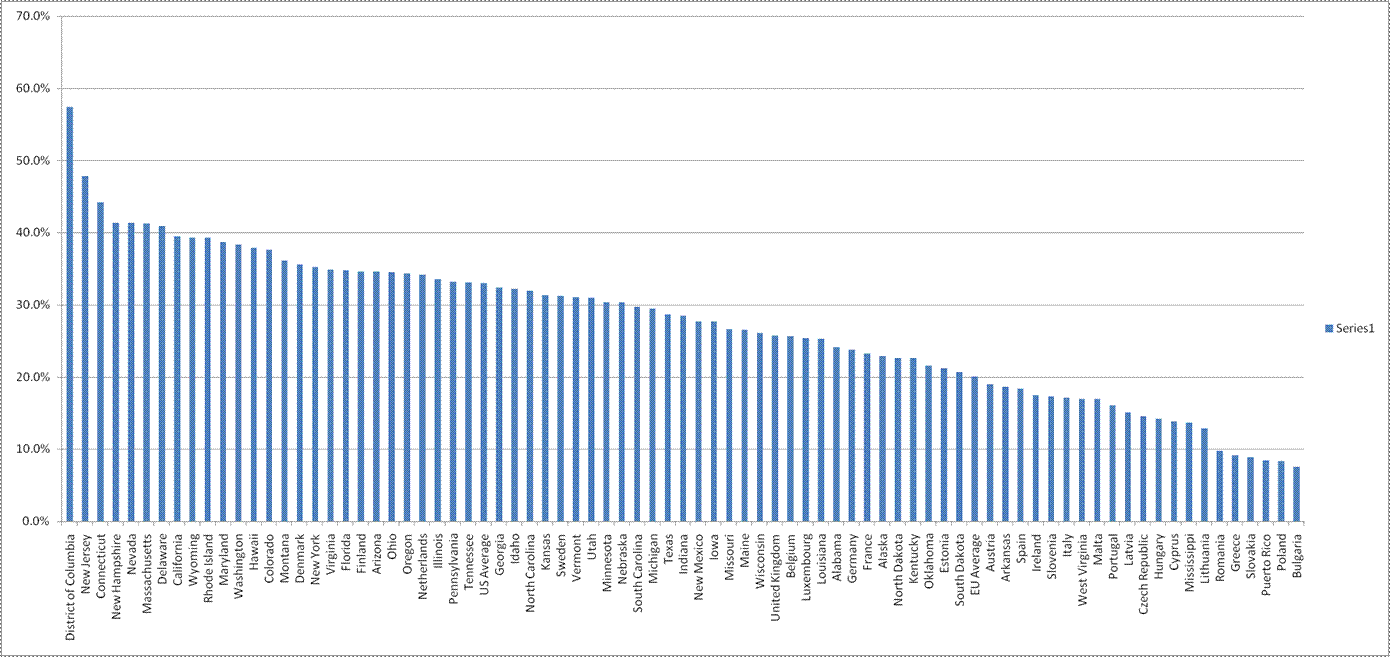
US/EU Broadband Comparison

Sean Donelan posted combined the data from the FCC and the EU report, and recalculted, eventually producing this chart (go here for the original):

20 March 2008

Broadband technologies in the US

The FCC released its latest report on broadband penetration (incidentally right on the heels of the EU's Review). While these broadband reports have been criticized, and the FCC will be adopting new reporting technologies (see this summary over at CNET), the data on technology use are still interesting and useful.

I have culled this graphic from Table 3 of this report. Plotting it in on a semi-log scale highlights the fastest growing technologies in addition to the ones in greatest use. You can see that, while cable modems are the dominant technology, followed closely by ADSL, the most rapid growth is in fiber and wireless. This should surprise no one, but it is interesting to see it graphically.

11 December 2007

AT&T network upgrades

Stories like this one in Forbes don't get a lot of press attention, but I think that they are worth tracking anyway. Since Forbes doesn't do permalinks, here are some key excerpts from the article:


AT&T Inc. said on Monday it has switched on its high-speed backbone network, which is designed to ferry data traffic across the U.S. four times faster.

AT&T has begun placing traffic on its so-called "ultra-long haul" network, which boasts a capacity of 40 gigabits per second, meaning consumers will be able to download large files quicker and more easily stream online videos to their computers. Carriers have been upgrading the backbone network - the underlying pipes needed to move data across extremely long distances - to meet the increasing demand in bandwidth-intensive programs and videos.

[...snip...]

The company, which is deploying routing equipment supplied by Cisco Systems Inc., has upgraded 50,000 miles of its network and plans to connect 25 major metropolitan areas in the next several months. ... In addition to a faster connection for consumers, the upgrades will help ease the capacity requirements for the company's U-Verse Internet-based TV system.

[...snip...]

While the network is the first in the U.S., Verizon Communications Inc. said that this month it would begin building a 2,000-mile backbone network connecting major cities in Europe.

Both companies plan to push the 40-gigabit standard in the U.S. and eventually upgrade to 100 Gbps.


The article doesn't mention it, but I think it is safe to assume that the "40 Gigabit" standard is, in fact, OC-768 (this article in Network World confirms this). NW also reports that this is AT&T's MPLS network. I'm not sure what the "100 Gbps" is ... OC-1536 comes in at approximately 80Gbps. Wikipedia reports that the OC-3072 standard is a "work in progress".

Could the 100Gbps bit rate be referring to 100 Gbps Ethernet (as this article in Wikipedia suggests)? That would be quite a departure ... and would suggest an explicit strategy to integrate local and long distance network standards. Ethernet has truly come a long way (pun intended)!

In light of the Comcast "network management" discussion, this is an interesting development. Do you think AT&T would be credible if they employed similar techniques on this new network?

30 November 2007

Broadband in Australia

You might find this item of interest ... there will be a cabinet level Minister for Broadband, Communications and the Digital Economy. One of the goals of this Minister is to implement the AU$4.7 Billion fiber to the node plan that was one of the promises of the recent election in Australia. So, following up on the point I was arguing here, how would one account for this in the OECD's price of service report? In other words, is it right to compare Verizon's retail price for FiOS (which did not receive a subsidy that I know about) with future services from Telstra and other Australian ISPs (which benefitted from this subsidy)?

FCC FSJB recommends funding broadband from the USF

Speaking of broadband, there is some interesting news on this front. The Federal-State Joint Board released this report recently. This group advises the FCC, in this case, on universal service policy. Thus, this report outlines recommended decisions that the FCC may or may not adopt. Responding to criticisms of the USF, the joint board recommended several actions:

  • Change funding structure to reduce burden on consumers
  • Change high cost program in several ways, including the introduction of three "funds": Broadband, Mobility and Provider of Last Resort (POLR)
  • Explore the use of reverse auctions to distribute funds

In doing this, the board is arguing that access to basic mobile voice and access to "broadband" is part of the universal service definition that should be funded.
They recommend that the broadband fund be approximately US$300 Million per year. They stop short of defining what they mean by "broadband" (which is not a trivial omission, since it affects cost in a significant way).

29 November 2007

OECD broadband statistics

he OECD recently published some updated broadband statistics. This was picked up and visualized by the San Jose Mercury News (as reported here -- the figure is pretty cool, by the way).

In looking at these new data, I asked myself the following questions:

  • What is really relevant here? Are users in "lagging" countries (like the US) getting their needs met? If yes, what is the problem?
  • In considering the reported data, they are advertised bit rates and retail prices. Is this really a fair if the prices are subsidized, either by tax subsidies, universal service funds, etc.? There is no doubt that there are serious methodological problems in counting and attributing subsidies, and using retail prices simplifies that.

Verizon Picks LTE for 4G Wireless Broadband

I have blogged about 4G technologies before. Now, in this item, Om Malik reports that Verizon has made its choice. He ties it to Verizon's recent announcement that they are opening their network:

The LTE evolution negates the GSM vs. CDMA debate, and it also promises global connectivity. In a recent chat, AT&T Mobility President & CEO Ralph de la Vega said that his company was going to migrate to LTE as the 4G solution. In such a scenario, you and I can then switch between the two services without worrying too much about handsets.

What does this mean for WiMAX?

Update (2007-11-30): CNet has a bit more to say about this in this article.

15 November 2007

Power line communications

I want to draw your attention to this item over at Ars Technica. While the story is mostly about a new chipset that ups the bit rate of this technology, the latter part begins exploring the market penetration of this technology (and the reasons for the current state of the market). Do you think that this is the elusive "third pipe" that many industry observers are looking for? Why or why not?

17 October 2007

Wither CableCARDs?

This article over at Ars Technica provides a nice, brief historical review of the CableCARD program. The goal of this program is quite clearly to promote competition in set-top boxes ... does it surprise you that it hasn't happened yet?

14 September 2007

Metered Broadband?

There have been a couple of articles about metering broadband (see this article at TLF and this response at Techdirt), which resulted in this debate. My $0.02?

  • It is clear to me that metering makes sense from a microeconomic standpoint, but only during episodes of congestion. If there is no congestion, the marginal cost of a packet is exceedingly small, so it may well cost more to collect and bill for traffic than the revenue it produces.
  • As a consumer of broadband services, I prefer to pay flat rate prices. My wireless provider gives me the option of different service levels, and I have chosen to pay more for the "unlimited" tier because I would rather not accept the risk of usage charges should I exceed my monthly allotment (I realize that "unlimited" may not actually mean "unlimited" ...)
  • As commenters on the previous posts have pointed out, telcos are profit maximizers, so metering is a way for them to price discriminate more finely than they now do with service tiers.

Since carriers have considerable freedom in setting prices, they have obviously determined that usage tiers make more sense for them than pure metered prices. Don't you think that they have calculated the costs and benefits of different pricing structures? Why are we having this debate in the first place, since consumers and carriers have clearly settled on a set of pricing and consumption structures independently?