14 May 2008

Wireless households

This item is interesting, even if the source (the Center for Disease Control) is a bit unusual. The picture says it all ...


but the quote is also worthwhile:
In the last 6 months of 2007, nearly one out of every six households (15.8%) did not have a landline telephone, but did have at least one wireless telephone. Approximately 14.5% of all adults-more than 32 million adults-lived in households with only wireless telephones; 14.4% of all children-more than 10 million children-lived in households with only wireless telephones.

The percentage of adults living in wireless-only households has been steadily increasing. During the last 6 months of 2007, more than one out of every seven adults lived in wireless-only households. One year before that (that is, during the last 6 months of 2006), fewer than one out of every eight adults lived in wireless-only households. And 2 years before that (that is, during the last 6 months of 2004), only 1 out of every 18 adults lived in wireless-only households.

The percentage of adults and the percentage of children living without any telephone service have remained relatively unchanged over the past 3 years. Approximately 2.2% of households had no telephone service (neither wireless nor landline). Approximately 4 million adults (1.9%) and 1.5 million children (2.1%) lived in these households.

09 April 2008

Photo essay on laying undersea cable

You might find this item over at CNET interesting. It is a photo essay on how undersea cables are laid.

26 March 2008

CDMA as an end-of-life technology?

This article in Telecom Magazine and written by Phil Marshall of the Yankee Group is interesting. Marshall writes:

The CDMA market is under long-term pressure in Brazil and is being swapped out for 3GSM in Australia. In Venezuela, Mobilnet has announced plans to overlay GSM on its CDMA network to reach low-end subscribers. In India, Reliance is migrating its CDMA network to GSM in urban areas. Neither Verizon nor Sprint has opted for long-term CDMA migration strategies. Sprint is planning a commercial launch of mobile WiMAX in April, and last November Verizon announced it will implement long-term evolution (LTE), a 3GSM migratory technology.

This, combined with the improvements in GSM technology, has removed many of the advantages that CDMA once had. This graph (from the article) shows CDMA slowing. Since LTE and other technologies don't enter into the technology mix until after 2011, it doesn't show a decline.

21 March 2008

US/EU Broadband Comparison

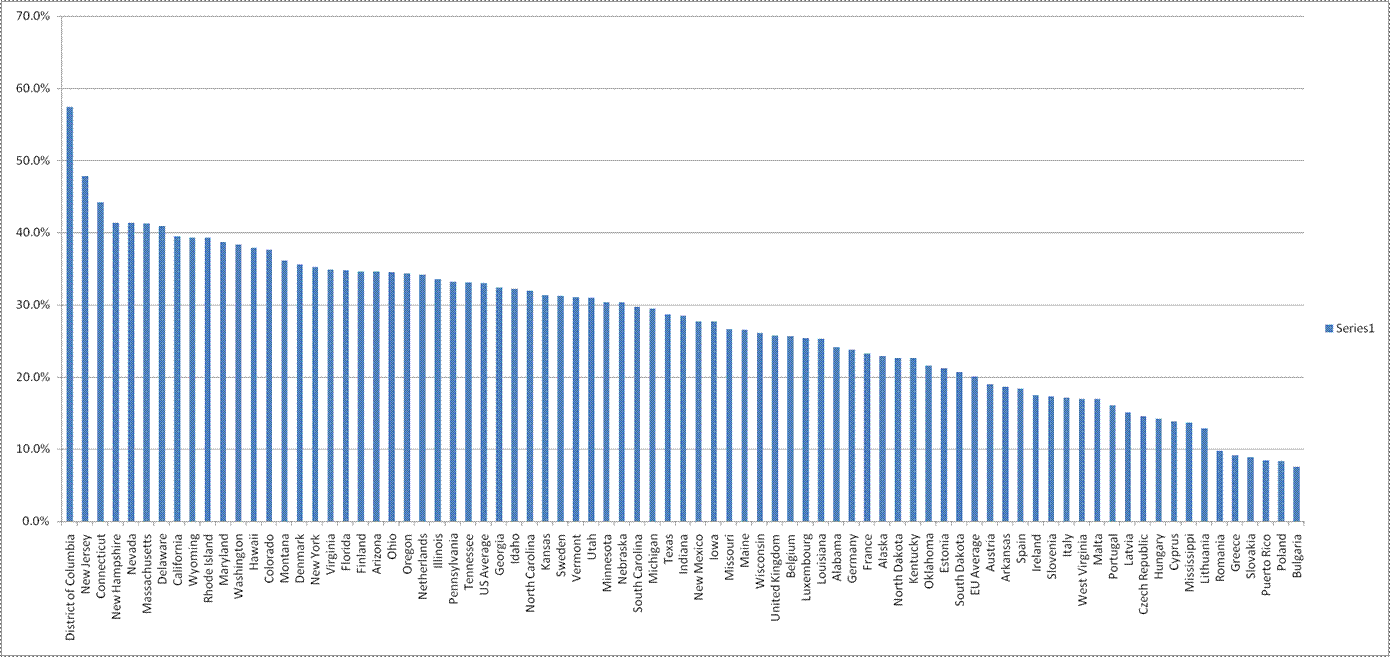
Sean Donelan posted combined the data from the FCC and the EU report, and recalculted, eventually producing this chart (go here for the original):

20 March 2008

Broadband technologies in the US

The FCC released its latest report on broadband penetration (incidentally right on the heels of the EU's Review). While these broadband reports have been criticized, and the FCC will be adopting new reporting technologies (see this summary over at CNET), the data on technology use are still interesting and useful.

I have culled this graphic from Table 3 of this report. Plotting it in on a semi-log scale highlights the fastest growing technologies in addition to the ones in greatest use. You can see that, while cable modems are the dominant technology, followed closely by ADSL, the most rapid growth is in fiber and wireless. This should surprise no one, but it is interesting to see it graphically.